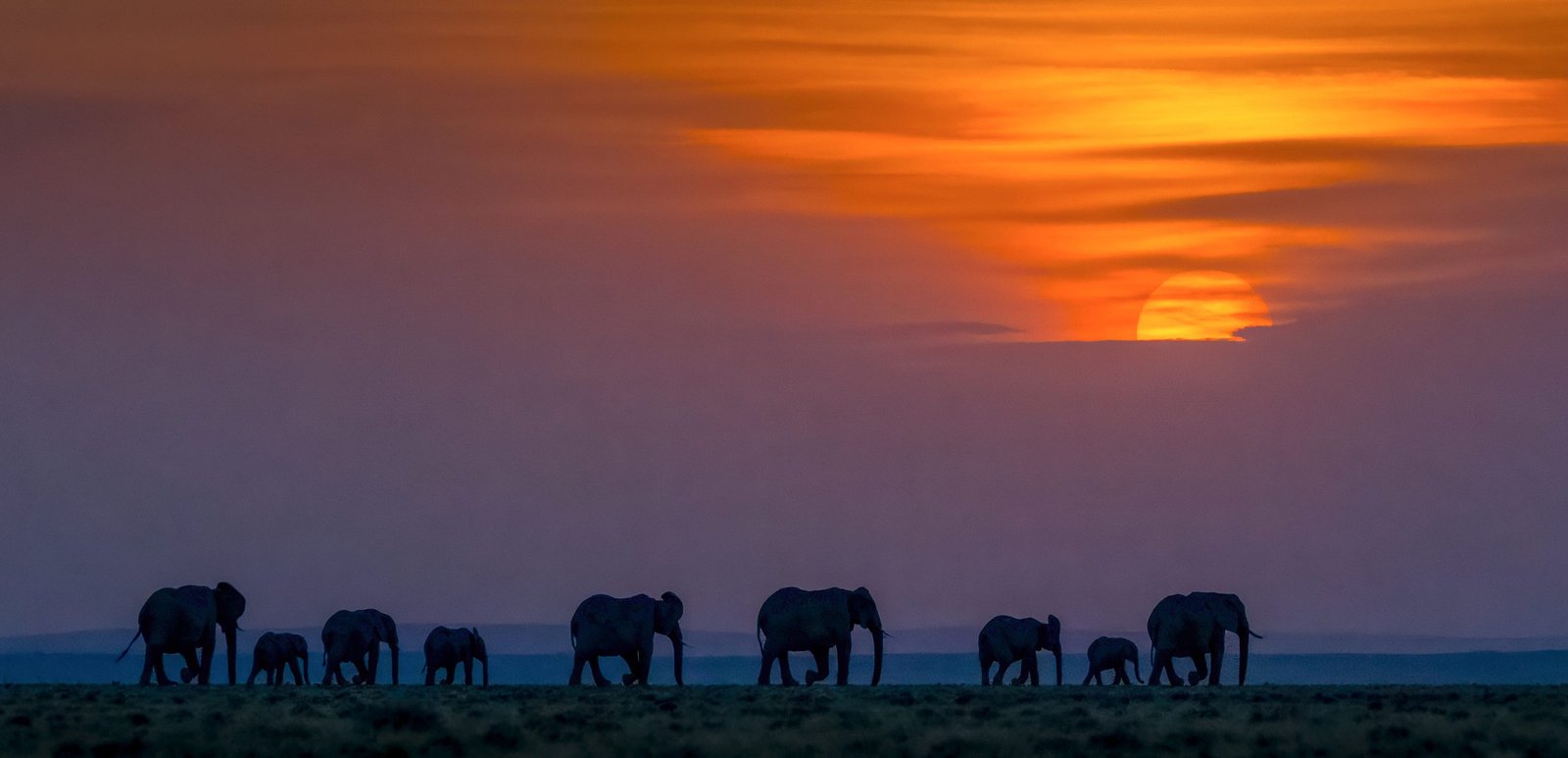
A pleasant surprise was waiting for me when I returned from my vacation in the Philippines.
My photograph, Elephant Parade, Amboseli, Kenya, had been awarded First Place in Photo Artfolio’s Wild exhibition.
And the $500 award was rather nice too! 😊
The news took me back to the morning I made the photograph.
It was dawn in Amboseli. While some photographers remained in the vehicle, I got out and sat on the ground. I followed the elephants with my camera as they moved toward the rising sun.
I kept shooting, anxiously waiting for the moment when their bodies would separate without overlapping—but would not spread so far apart that the sense of a family moving together was lost.
As luck would have it, everything came together as they approached the sunrise. Their bodies formed a nearly perfect line. Each elephant was clearly visible, with no overlap.
I photographed from as close to the ground as possible, intending to create a clean silhouette and reduce distractions along the horizon. I was concentrating on the practical decisions photographers make almost instinctively: viewpoint, timing, spacing, background, and light.
I was thrilled when their silhouetted bodies became almost perfectly aligned near the rising sun. To this day, I have rarely seen another photograph in which an elephant family is so clearly separated and yet so closely connected in such a serene atmosphere.
Nature had provided the elephants, the landscape, and the light, leaving me to choose the viewpoint, watch the spacing, and recognize the instant when everything came together.
The scene was mesmerizing and felt almost sacred in the stillness, as we sat silent, respectful, and as motionless as we could manage.
Amboseli is known for its elephants and its wide-open views. In such a landscape, even animals as large as elephants can appear small. The expansive sky dominates the photograph, while the herd crosses a narrow strip of earth beneath it.
That sense of scale became an important part of the image.
Wildlife photographers often want to get closer. We look for expressions, behavior, and details. But this photograph works for almost the opposite reason. The elephants’ shapes and movement become the main subject, silhouetted against the rising sun.
Elephant families have strong and lasting relationships. They move together, care for their young, share information, and respond to one another. An experienced matriarch often plays an important leadership role, although decisions about movement can involve other members of the family as well.
In this image, we can see that the younger elephants are in the middle of the line, surrounded and protected by the adults.
Elephant families in Amboseli often travel from the bushlands across the open plains toward the permanent swamps, where they drink and feed. This pattern is especially strong during the dry season, although routes vary by family and season.
Most likely, this procession was making that morning journey. I could not know for sure, but the elephants appeared to be moving together with a destination and purpose.
We tried not to disturb them. They did not turn toward us or acknowledge our presence. They were not performing for my camera. They were simply moving through their landscape.
For one brief moment, the spacing, movement, light, and landscape came together. And I was fortunate enough to be there.